PART ONE — FOR THE STUDENT
Chapter 1
College Is Not High School With Better Snacks
The scariest thing about college is also the best thing about it: nobody is coming to check on you.
Somewhere in your first week of college, probably on a Tuesday, you will notice something strange. You skipped breakfast, nobody said anything. You were four minutes late to class, nobody wrote it down. You have reading due Thursday that no one will collect, a paper due in October that no one will remind you about, and an entire afternoon — a real, whole, unclaimed afternoon — that belongs to absolutely no one but you.
High school you would have called this paradise. Give it three weeks. Around week three, the same silence starts to feel less like freedom and more like standing on a stage where the director, the script, and the audience have all quietly left the building. That moment — the Tuesday you realize nobody is running your life anymore — is the actual beginning of college. Everything before it is just moving in.
This chapter is about that moment. What really changed, why the change wrecks smart people who don’t see it coming, and the small set of moves that separate the students who thrive from the students who spend freshman year treading water. None of it requires talent. All of it requires seeing the game clearly before you play it — which, as of this page, you do.
The Scaffolding Is Gone
Think about how much of your success in high school was actually helped by other people. Someone may have woken you up. Someone may have decided when you ate. A bell told you where to be, up to eight times a day. Teachers collected homework weekly, which forced you to do it, which meant that by exam time you had accidentally studied for weeks. Coaches scheduled your exercise. Parents watched your sleep, your grades, your moods, and stepped in before small slides became big ones. If you started failing, an adult noticed within days and a meeting appeared on somebody’s calendar.
That whole invisible machine — call it the scaffolding — was doing more work than you ever saw. And over one summer, it is dismantled completely. Not gradually. Completely. College replaces it with nothing except a syllabus and a shrug.
Here is the part nobody says plainly. The scaffolding was never a comment on your ability, and its removal isn’t either. The freshmen who stumble in October are not dumber than the ones who don’t — they are usually the ones who never realized how much scaffolding they were standing on, because it was invisible while it held. Straight-A high school students are, if anything, more at risk. Their scaffolding was excellent, so they’ve never once had to build their own.
So the first honest question of your college career is not ‘am I smart enough?’ It’s ‘what was the scaffolding doing for me, and which parts do I now have to rebuild myself?’ The list is short, and it is the entire difference, so make sure to PLAN for the points below:
- Sleep that happens on a schedule instead of by collapse.
- Food that happens on purpose (more on this in Chapter 8).
- Deadlines tracked somewhere outside your own memory.
- Starting things before they become urgent.
- Noticing when you’re sliding — early, while it’s still cheap and somewhat easy to fix.
Nobody Checks. Everybody Notices.
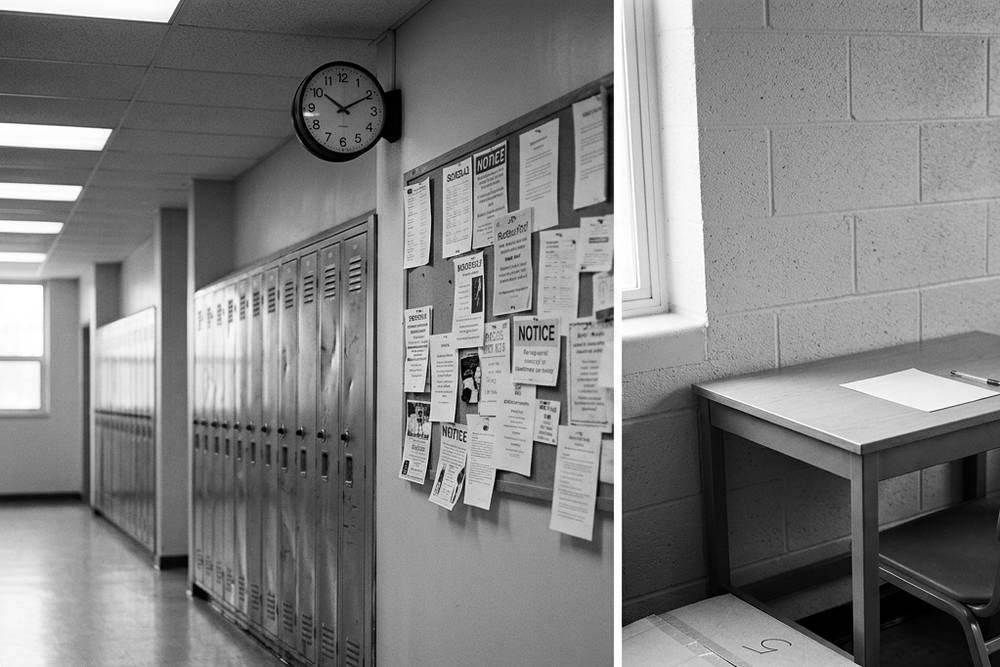
The strangest paradox of college — no one is checking on you, and yet everything is being noticed. No professor will call home about your attendance, but as you’ll see in Chapter 7, they know their regular faces within three weeks, and it quietly shapes every borderline decision they make about you. No one collects the reading, but the first exam collects it all at once, with interest. No one comments when you stop making it to the dining hall before noon, but your energy, your mood, and eventually your transcript are keeping the record.
College doesn’t punish you in the moment, the way high school did with detentions and phone calls. It lets consequences accumulate silently and then delivers them in a lump — the midterm you weren’t ready for, the 8 a.m. class you’ve stopped attending, the registration day you slept through. The feedback still exists. It’s just been moved from daily to monthly, and by the time a monthly consequence arrives, it’s expensive. A good rule of thumb to live by that describes this period precisely: ‘Your Choices, Your Consequences.’
The move, then, is to become your own early-warning system, because the institution’s is gone. The students who thrive check themselves weekly — fifteen minutes, usually Sunday — before the institution checks them monthly. What’s due in the next two weeks? What am I behind on while it’s still able to be fixed? Am I sleeping? When did I last do something with another human? That’s not self-help. That’s replacing the most important thing the scaffolding used to do. Chapter 6 gives you the full system. For now, just accept the principle — in college, if you don’t check on yourself, the first thing to check on you will be a transcript.
The Freedom Math
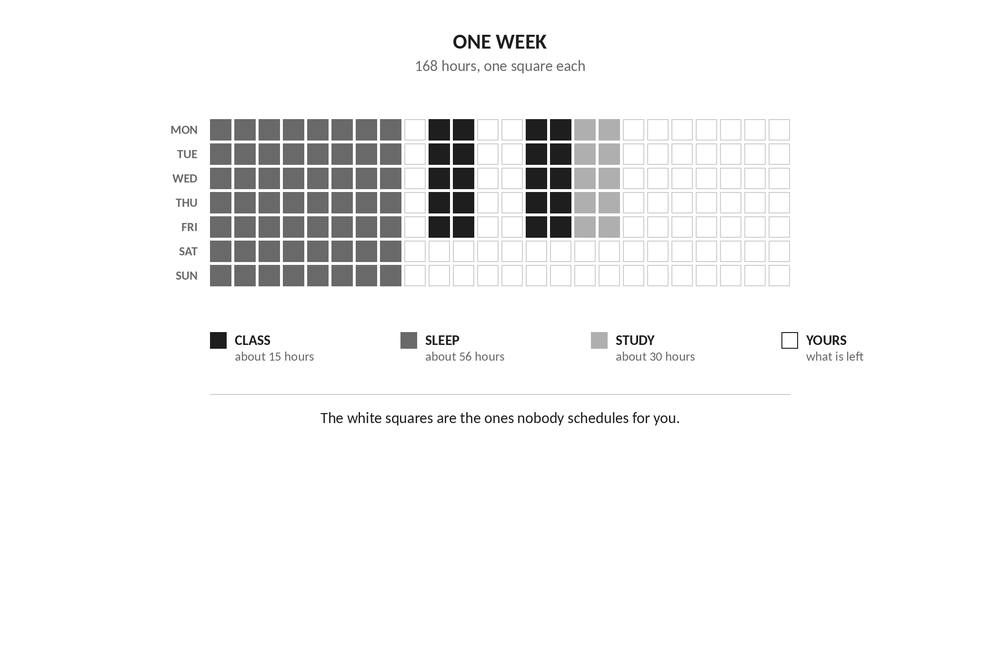
Let’s do the math that explains basically everything about freshman year. Start with the week every human gets and subtract what college actually requires:
- 168 hours in every week.
- About 15 in class (yes, only fifteen — check your schedule, and make sure you KNOW how many credit hours your program requires for ‘full-time’ status).
- About 50 asleep, if you’re doing it right.
- About 30 of real studying — the two hours outside class for every hour in it that college quietly expects (Chapter 5 has the receipts).
- Roughly 70 hours left over, every week, that belong to no one but you.
Seventy hours. That’s more unstructured time per week than you had in a month of high school. It’s where everything good about college lives — the friendships, the clubs, the 1 a.m. conversations, the person you’re about to become. And it is exactly where freshman year goes to die, like one ‘we ordered food and watched stuff until 3’ night at a time.
Nobody manages those seventy hours for you, and here’s the trap — they don’t arrive labeled. The afternoon that could hold the gym, the reading, and dinner with your floor looks identical to the afternoon that evaporates into your phone. Both feel the same at 2 p.m. Only one of them feels the same at 11 p.m.
You don’t need to schedule all seventy hours — that’s its own disease, and Chapter 6 will talk you out of it. You need to claim about twenty-five of them on purpose:
- Study blocks that exist before they’re emergencies.
- One thing weekly that puts you in a room with the same people (that’s how friendship actually works — Chapter 5).
- Meals at tables instead of desks.
- A bedtime that’s a decision instead of a surrender.
Claim twenty-five, and the other forty-five are guilt-free. That ratio — deliberate first, free second — is the whole art of college time.
The Reset Button Nobody Mentions
Now the good news, and it’s enormous. On this campus, nobody knows you were the ‘shy one.’ Nobody knows about ninth grade, the friend group that imploded, the reputation you couldn’t shake, the version of you that formed by accident in middle school and then hardened. Every expectation that accumulated around you for thirteen-ish years — gone, overnight, along with the scaffolding.
This is the largest social reset you will ever be handed, and it has an expiration date. In the first six weeks, everyone is unformed and everyone is auditioning. By Thanksgiving, this campus will have decided who it thinks you are, mostly based on what you did in September. That’s not pressure — it’s leverage. It means the habits you’d like to be known for cost about six weeks of deliberate behavior to install permanently.
So decide — actually decide, this week, maybe in the margin of this page — two or three things about the person who’s showing up here. Not a fantasy self. You can’t sustain a personality transplant, and you don’t need one. Pick from versions of you that already exist:
- The one who asks the question.
- The one who shows up on time.
- The one who says yes to the dining-hall invitation.
- The one who goes to the thing alone.
Be that on purpose for six weeks, and this campus will simply believe you’ve always been that person. Because here, you have.
What Thriving Actually Looks Like (It’s Not What the Brochure Said)
Let go of the montage version of college success — the 4.0, the president-of-three-clubs, the packed calendar of a person who is secretly miserable. Two decades of watching real freshmen tells me thriving looks like this instead:
- You know what’s due before it’s urgent.
- You have two or three real people, not forty acquaintances.
- You’re in one thing that meets weekly, where people expect you.
- You eat and sleep like someone with plans for the next decade.
- You’ve talked to at least one professor who knows your name.
- When a week goes sideways — a bombed quiz, a roommate fight, a bad night — you have an option that isn’t ‘hide.’
Notice what’s on that list. Systems and people. Notice what isn’t — brilliance, perfection, or busyness. Every chapter in Part One is really just one item from that list, expanded into a playbook. The room that works (Chapter 2), the roommate treaty (Chapter 3), the neighborhood (Chapter 4), the first six weeks (Chapter 5), the seventy hours (Chapter 6), the professors (Chapter 7), the money and the maintenance (Chapter 8), and the hard weeks (Chapter 9).
And notice one more thing. Everything on the thriving list is available to every student on campus, regardless of high school record, regardless of how socially smooth they are, regardless of money. The game changed when the scaffolding came down. The new game is learnable. That’s the secret hiding inside any bad day.