PART ONE — FOR THE STUDENT
Chapter 10
Student FAQ: Things You Wish You Knew Before Starting College That No One Ever Told You
There is no manual. There is only a few million people your age improvising at the same time.
Every August, a few million people your age pack up their lives and drive toward a building full of strangers, and every single one of them is handed the same brochure advice — get involved, manage your time, call home. All true. All quasi-useless, because it isn’t the stuff you actually need to know.
What follows is the other list. The things sophomores wish someone had told them in August, collected here and answered straight. No warnings from the school, no lectures from home. Just the answers.
Read it now, then read it again in October. Half of these won’t make sense until they happen to you.
The Social Illusion
Does everyone else already know each other?
No. It is an illusion, and it is the single most convincing illusion of your first month. Those laughing groups in the dining hall met eleven days ago. The person who seems to know everyone is working exactly as hard as you are — they just started talking first. For roughly six weeks, the entire freshman class is ‘performing’ confidence at each other. The moment you understand that everyone is faking it, you stop being intimidated by people who are exactly as nervous as you.
How fast do friendships actually form, and are my first friends my real friends?
Fast, and probably not. Your orientation-week friends are proximity friends — you grabbed each other like life rafts. Some become real. Most fade by Thanksgiving, and that is normal, not a failure. Your actual college friends tend to show up in weeks four through ten, through classes, clubs, and the friend-of-a-roommate pipeline. So keep saying yes to things even after you ‘have a group.’ The group you have in September is rarely the group in the graduation photos.
Is it weird to eat alone?
Nobody is looking at you. TRULY, nobody. Half the dining hall is eating alone with headphones in, and none of them are being judged either. That said, the dining hall is the easiest, lowest-bar social tool you own — ‘mind if I sit here?’ has a roughly one hundred percent acceptance rate in September. Use it while the window is open.
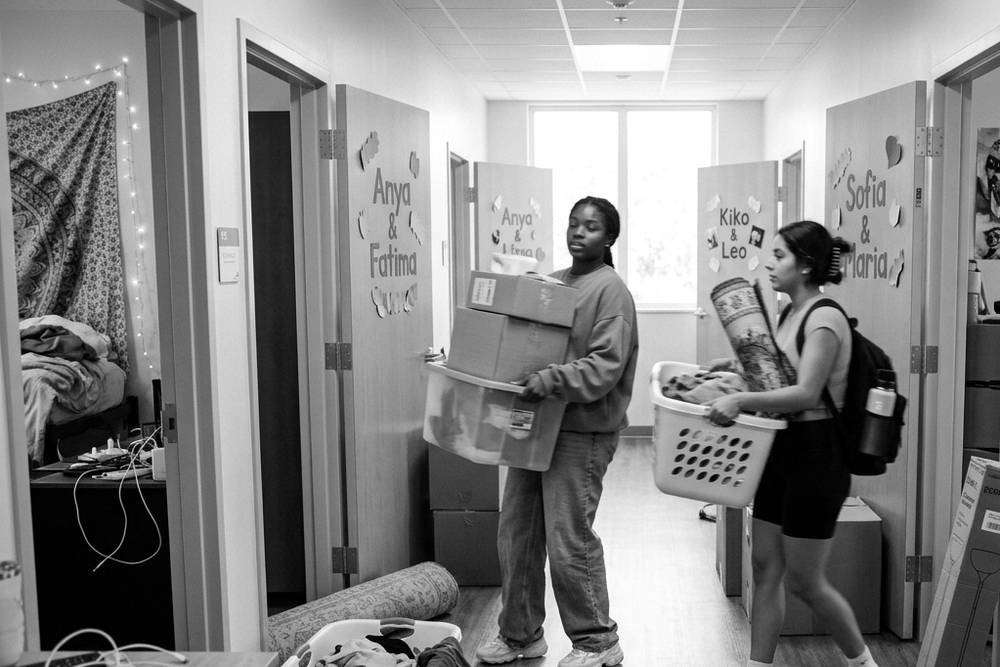
Everyone on my floor leaves their door open. Do I have to?
The open door is the oldest social technology in dorm life, and it means one thing — you can say hi. You don’t have to adopt it, but understand the trade. In the first month, the open-door rooms become the default hangouts and their residents get a social head start for free. Prop it open while you unpack, while you watch something, while you do easy homework. Close it when you need to actually work or actually sleep. Both are allowed.
What do I actually wear? Is everyone dressed up?
Within two weeks, the entire campus converges on sweatpants or some version of relaxed, pajama-like clothes. Nobody remembers or cares what you wore. The freshman tell isn’t clothing — it’s the lanyard around the neck. Pocket the keys.
How do I join things without overcommitting?
Sign up for everything at the club fair, because the email lists cost nothing. Attend five things once. Commit to two things twice. By October you want exactly two ongoing commitments — one connected to your future (major club, research, a team) and one that is pure joy. More than three and your grades pay for it. Zero and your loneliness does.
Is it too late to make friends after the first month?
No, and believing it is too late is the actual mistake. The friend groups that form in week one are soft — they reshuffle constantly through the whole first year. Clubs, jobs, study groups, and spring roommate hunting all reopen the market. The only people who stay lonely are the ones who decide in October that the music stopped. It didn’t. It never really does.
The Academic Reality
How much should I actually study? Nobody will tell me a number.
Here is the number — plan for two hours outside class for every hour in class. Fifteen credit hours means thirty hours of reading, problem sets, and writing, which is a full-time job’s worth in total. Almost nobody does that in week one, which is why almost everybody is stunned by their first midterm. You will not need all thirty hours every week. But PLAN for them, and the weeks that need them won’t wreck you.
When is the first exam, really?
Sooner than feels fair — typically week four to six, when you are busiest socially and least established academically. The students who do well on it started in week one, not because they are smarter, but because college grades are usually built on four or five events, not forty homework grades. There is no cushion. Know your syllabus dates on day one. They are the only warning you get.
What is the biggest academic difference no one explains?
Nobody checks. That’s the whole thing. No one takes attendance in half your classes, no one collects homework, no one calls home. Every structure that held you up in high school is gone, and it isn’t replaced with anything except you. This is either the best news of your life or the reason for your first academic crisis, and the deciding factor is whether you build your own structure in the first two weeks or wait for someone to make you.
Do people actually skip class? Should I?
They do, and the math says don’t. Divide your tuition by your number of class meetings — each lecture is a three-figure purchase you already made. More practically, attendance is the single strongest predictor of grades that you fully control, and professors quietly notice the faces that are always there. Skipping is a habit with a slope. The first skip is free. The fifth one is your GPA.
What do I do the first time I fail something?
First, a failed exam in college is data, not a final verdict. The grading is harder and the first exam of a course is where everyone finds out what the professor actually wants. Second, the move that separates students is what happens in the next 48 hours. Go to office hours with the exam, say ‘I want to do better — where did this go wrong?’, and adjust how you study, not just how much. Professors keep quiet mental lists of students who do this. It is the single most respected move in the building, and the full playbook is back in Chapter 7.
Nobody told me about the paperwork. What administrative traps should I know?
Three dates rule your life and nobody makes you learn them:
- The add/drop deadline — a free undo button on any course, for about two weeks.
- The withdrawal deadline — a W on a transcript beats an F, always.
- Registration day for next semester — the good classes go in minutes, so know your time slot and have backups picked.
Put all three in your phone in week one. And KNOW how many credit hours your program requires for full-time status, because dropping below it can quietly affect financial aid, insurance, and housing. Read the emails from the registrar — buried in the boring ones are the deadlines that cost real money.
The Room and the Roommate
My roommate and I aren’t becoming best friends. Did I fail the roommate lottery?
You won it, actually. The goal of a random roommate isn’t friendship — it’s a functional treaty between two strangers sharing two hundred square feet. Best-friendship is a bonus with real costs when it goes bad. Aim for respectful, communicative, and boring. The pairs that end badly usually failed at logistics (sleep, guests, noise, stuff), not friendship. Have the boring conversation about those four things in week one and you are ahead of most of your floor.
What do I do when my roommate does something that drives me crazy?
Say something the second week it bothers you, not the eighth. The formula is smaller than you think — name the thing, not the person. ‘Hey, I have an 8 a.m., can we figure out a lights-out plan for weeknights?’ beats three months of silent fury followed by an explosion over a toothbrush. Passive aggression (the note, the sigh, the subtweet) reads as hostility and fixes nothing. If a direct conversation fails twice, that is what your RA is for. Involving them isn’t tattling, it’s using the building’s built-in mediator.
What is the one supply nobody brings and everyone needs?
Basic medicine. At 2 a.m. with a fever, the campus store is closed and whoever takes care of you at home is far away. Bring the small pharmacy — fever reducer, cold medicine, stomach stuff, bandages, a thermometer. (There is a full pre-move checklist you can print at ElevateMyDorm.com, along with your specific dorm’s room dimensions so you buy things that actually fit. Half of what freshmen ship to school goes home in May unused.)
The Body, the Budget, and the Basics
How do I handle laundry, actually?
Wash everything in cold, separate nothing, and you will be fine. The sorting rules your grandmother knew were for fabrics you don’t own. Dark towels can’t show stains. Set a timer when you start the machine, because the person who leaves clothes in a shared dryer for three hours becomes the villain of the floor. Sunday morning is the secret empty-laundry-room window.
What food rules keep me from feeling terrible by October?
Three, and they’re the whole game:
- Eat a vegetable on purpose once a day.
- Keep real breakfast food in your room, so the dining hall isn’t a prerequisite for functioning.
- Treat late-night delivery as a special event, not a Tuesday habit — it is the quietest budget-killer in college.
The ‘freshman fifteen’ is less about the dining hall and more about eating a second dinner at midnight four times a week.
How does money actually disappear?
Four dollars at a time. Almost no freshman is wrecked by a big purchase — they are wrecked by coffee, delivery fees, and rideshares, which is eleven small yeses a week. And you can’t feel it happening, because you are the first generation to go to college nearly cashless and a tap shows you nothing. So do the two things in Chapter 8. Pick a weekly number for spending money and glance at it every Sunday, and put that number somewhere that does the subtraction for you as you spend, like RealTimeBudget.com or something similar. Do not try to run on cash — campus barely takes it. Carry one emergency twenty and nothing more. Also KNOW the difference between the meal plan money that expires and the money that doesn’t. Every campus has students who discover an expiring balance in December and panic-buy forty granola bars.
What about parties, actually — no lecture, just the truth?
The truth is that they are less central than movies promised, and the people who make them their whole personality in September are usually struggling by November. Go if you want. Go with people you came with, keep track of your own cup, and have a leave-together agreement before you arrive. The most valuable party skill is the confident early exit. Nothing good happens after the point where you’d text someone you shouldn’t.
Is it okay that I don’t drink?
Completely, and you will be less alone in it than you expect. The share of students who don’t is far larger than a Friday night makes it look. Nobody interesting cares. ‘I’m good’ is a complete sentence, and the person offering forgets the exchange in nine seconds. Find the late-night food group — every campus has one, and they are having a better time than half the party.
The Hard Parts
What’s the deal with homesickness? When does it hit?
Usually not in week one, because week one is adrenaline. It hits in weeks three through six, when the novelty burns off and the texture of home (your dog, your bed, food that isn’t from a tray) gets loud. It is nearly universal and it is not a sign you chose the wrong school. Treat it like weather — real, uncomfortable, passing. The mistake is going home every weekend to escape it, because students who do never finish moving in. Give it until Thanksgiving before you judge anything.
Everyone else seems fine. Why am I the only one struggling?
You are seeing everyone’s ‘performative’ exterior and comparing it to your interior pit of despair. The student who seems effortlessly happy posted the one good hour of a hard week. By midterms, the number of freshmen who have cried about something — grades, loneliness, a call home — is close to all of them. The fine-seeming people aren’t evidence you are behind. They are doing what you are doing, which is performing okay while figuring it out.
When should I actually use the counseling center?
Before you think you qualify. Campus counseling isn’t the emergency room, it’s an oil change, and your tuition already paid for it. The students who use it early — for stress, sleep, a rough transition — do dramatically better than the ones who wait for a crisis to justify the appointment. Book it the way you’d book a haircut. Nobody is notified. It goes on no record that follows you.
My high school friends are drifting. Is that normal?
It is the most normal thing in this entire list. The group chat slows, the daily texts become weekly, and Thanksgiving is honestly strange — everyone comes home slightly different and slightly performing their new life. The friendships worth keeping survive on one good call a month, not constant contact. Let the rest go with gratitude. You aren’t betraying anyone by growing.
How often should I call home?
More than never, less than daily, and ideally on a rhythm you choose — because if you don’t choose one, the anxiety back home will choose one for you. A standing Sunday call is the single cheapest way to buy yourself a low-surveillance week. People who know the call is coming stop pinging you Tuesday at midnight. And call occasionally with good news. If home only hears from you in crisis, home starts to panic every time the phone rings.
The Stuff Nobody Mentions
What do upperclassmen know that freshmen don’t?
- That the library has floors with personalities, and the good one is never the first floor.
- That professors are the most underused resource on campus (again — Chapter 7).
- That the add/drop period is for auditioning courses, not suffering through them.
- That campus jobs are the best-kept secret on campus — paid hours, built-in friends, and bosses who write recommendation letters.
- That syllabus week is for reading syllabi, which sounds obvious and is somehow the rarest behavior in the building. That syllabus is your course contract…KNOW it!
- And that everything, EVERYTHING, is easier the second semester.
What’s the one thing to get right in the first 72 hours?
Say yes to every low-stakes invitation — the dining hall walk, the store run, the terrible movie in the lounge. The first 72 hours are the only time in your life when ‘want to come?’ is the ambient state of an entire community. You can skip any one of those invitations harmlessly. Skipping all of them is how the door quietly closes. It reopens, as covered above, but it is so much easier to walk through while it’s wide open.
And the one thing everyone gets wrong?
Believing that everyone else got a manual they didn’t. There is no manual. There is only a few million people your age improvising at the same time, a campus full of adults who are paid to help you and mostly never asked, and a version of you — about eight months from now — who walks across that same quad like they own it. You will not believe how fast that happens. TRUST ME on this one. Keep this book, because you’ll want to check.