PART ONE — FOR THE STUDENT
Chapter 5
The First Six Weeks Decide Your Year
Colleges have known for fifty years that the first six weeks predict the next four years. Nobody thought to tell the freshmen.
Here is something I knew as an administrator and professor that students were never told directly. Inside every university, there is an office watching the first six weeks of freshman year the way meteorologists watch a hurricane season. Retention research — the field that studies who stays in college and who quietly leaves — has pointed at the same window for two generations. Students who connect to people and purpose in roughly the first six weeks overwhelmingly stay and thrive. Students who drift through that window unattached are the ones the statistics start following.
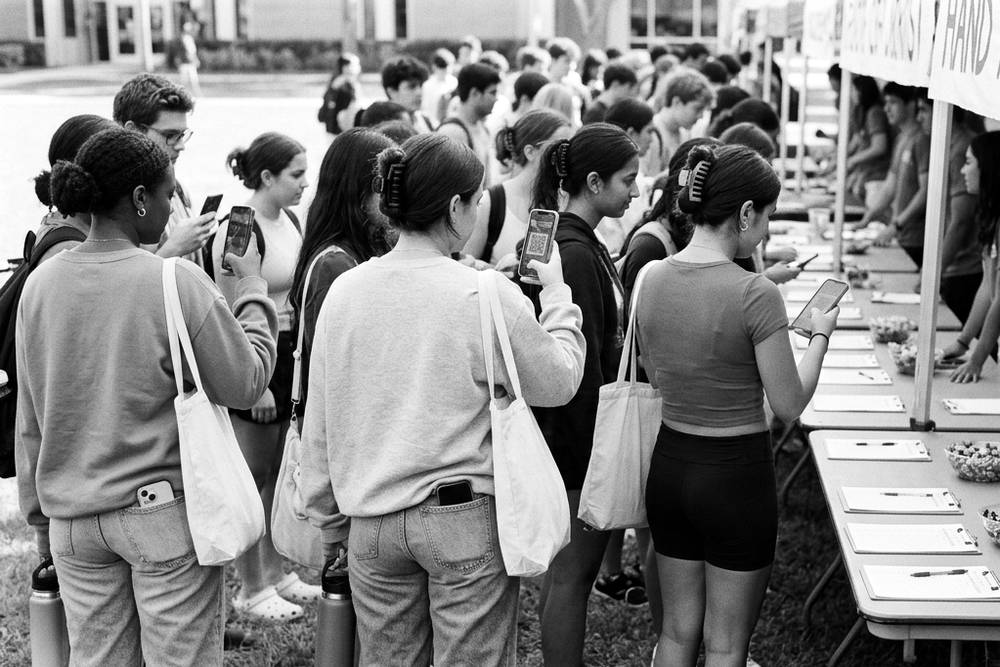
Universities respond by aiming everything at that window. The welcome weeks, the activity fairs, the free food, the endless events that seem excessive in September and vanish by October. None of that programming is random. It is an institution spending millions to do one thing — collide you with people and commitments while the collision odds are still hot.
This chapter tells you what the institution knows, and then hands you the version of the plan you can actually run. How the social window really works, the two-commitment rule, the academic habits to install before the first exam ambushes you — and why the whole thing is more forgiving than the word ‘decide’ in the title implies. The window matters enormously. It is also not the only window, and knowing both of those things is the whole game.
Why Six Weeks: The Ways of the Window
The window isn’t magic — it’s three forces stacking.
- Universal openness. For a few weeks, every freshman is unattached and actively recruiting. ‘Want to come?’ is the ambient state, the invitation acceptance rate is nearly perfect, and joining is frictionless because nothing has formed yet.
- Forming groups. Humans group together fast, and once groups form they don’t exactly close to others — but they develop a cohesion of shared experiences. Joining a formed group takes an introduction. Joining one that is still forming just takes being around and engaging.
- Habit-setting. Your own routines — where you eat, when you study, whether you go out or stay in — harden in about the same six weeks, and the hardened routine of a person who stayed in is a difficult thing to renovate in November.
Put the three together and you get the real rule. The first six weeks are the lowest-effort of forming friendships and habits. Think of it like a store…everything is still available and everything costs almost nothing. Week two’s ‘mind if I sit here?’ costs one breath. The same sentence in week ten costs a small act of courage. Same sentence, same you — the price just went up.
So the strategy is not ‘be amazing for six weeks.’ It’s simpler and dumber. While everything is cheap, buy broadly. Say yes widely, sit with strangers, take every flyer at the fair. You are not choosing your people yet — you are stocking the shelves at the store you’ll shop from all year.
The Two-Commitment Rule
By the end of week six, you want exactly two standing commitments — things that meet weekly, where specific humans expect specific you.
- One connected to your future. The major’s club, undergraduate research, the pre-professional society, a team, the campus paper, a job. This one starts the network Chapter 7 will teach you to build, and makes your major a community instead of a course list.
- One that is pure joy with no resume value whatsoever. Intramural anything, rock climbing, ultimate frisbee, the terrible-movie club, a choir. This one keeps you sane and hands you friends outside your academic bubble — insurance you’ll want by midterms.
Why exactly two? Because the failure modes on either side are the two most common freshman-year wrecks. Zero commitments means no standing collisions — the proximity-repetition machine from Chapter 4 never runs beyond your hallway, and loneliness arrives with the cold weather. But the overcommitment trap catches the strongest students. The high school habit of nine activities meets college’s seventy free hours, everything gets a yes, and by October you are triple-booked, exhausted, and doing nothing well — including the classes that are, per the freedom math of Chapter 1, a full-time job. Two standing commitments, plus classes, plus a social life, is a full week. The math does not care about your high school resume.
The audition process works like this:
- Sign up for everything at the fair. Email lists are free.
- Attend maybe five things once.
- Return to two things twice.
- Commit to your two, and quit the rest without guilt. The fair signup was an audition, not a marriage.
One special mention for the campus job, ten hours a week or so. It pays, it builds the weekly-collision structure, it comes with a boss who writes recommendation letters, and the research consistently finds that students who work moderate hours do better academically than students who work zero — because nothing teaches the time skills Chapter 6 will preach like having less time.
The Social Plays, Run Honestly
Some concrete mechanics for the window, especially if ‘just be social’ has always sounded like advice written for someone else.
- The dining hall is the highest-value venue. Eat at peak hours, not off-peak. Sit at the long tables, not the two-tops. And use the September sentence — ‘mind if I sit here?’ — while it’s still cheap. Meals are the only campus activity everyone must do daily, which makes them the most reliable collision generator you have.
- Claim a seat neighborhood in class (Chapter 7 will tell you to sit in the front third — start now) and talk to the same two people twice. ‘Did you get what she meant about the reading?’ is a friendship seed disguised as an academic question. Class friends become study groups, study groups become actual friends, and this pipeline keeps producing all year.
- Be the one who converts acquaintance into plan. The entire freshman class is standing around liking each other, waiting for someone else to say ‘we should get food — are you free Thursday?’ The person who says it is not the neediest one in the room. They are the one everyone is quietly grateful for.
Specific beats vague, every time. ‘We should hang out sometime’ is a pleasantry. ‘Thursday, six, the dining hall’ is a friendship. If you do exactly one hard social thing per week from this chapter, make it that sentence.
Meanwhile, the Academic Clock Is Running
Here is the collision hiding inside the window. The same six weeks that host your entire social formation end, almost everywhere, with the first round of exams. The freshman who spends September fully social and opens the books in week five discovers — along with a large share of each year’s freshman class — that college grading has no cushion (Chapter 1 warned you — four or five events, no homework padding) and that the syllabus said so all along.
The academic moves for the window are few, cheap, and non-negotiable.
- Go to everything. Attendance is the price of admission to the whole strategy, per the tuition math you already did.
- Do the reading before lecture. It converts every class from dictation into review and cuts exam studying in half. The two-for-one hour ratio from Chapter 1 mostly lives here.
- Form a study group by week three from those class-seat neighbors. It’s simultaneously an academic tool and a social play — the rare move that scores in both columns.
- Visit one professor’s office hours before anything is wrong. Chapter 7 will show you why this is the highest-return move on campus — and week two is when the room is emptiest.
- Build backward from the first exam date. The dates went into your phone on day one (the Week-One Five), so real studying starts a week out, not the night before. The first exam sets your baseline with every professor and, more dangerously, with yourself.
That first result deserves one framing sentence before it happens. Whatever it is, it is calibration, not identity. A strong start is a baseline to defend. A weak one triggers the 48-hour rule Chapter 7 will hand you — the office-hours visit, the diagnosis, the adjustment — and becomes the origin story of a comeback. What it never is, either way, is a verdict on whether you belong here.
If the Window Closes on You Anyway
Now the honest section, because some of you will read this chapter in October with a sinking feeling. Maybe homesickness ate September — it hits hardest in weeks three through six, exactly on top of the window, and Chapter 9 takes it seriously. Maybe your floor was the dud from Chapter 4. Maybe you did everything right and it just hasn’t taken. Here is what the retention research also shows, and what the doom-flavored version of the six-weeks rule leaves out. The window is when formation is cheapest, not the only time it happens.
- Friend groups reshuffle constantly all year — after midterms, over winter break, at housing selection.
- Clubs take joiners in January, and study groups form before every exam.
- Campus jobs post every month.
- Spring semester is a full second act, with a cast that now includes plenty of people whose September groups quietly dissolved.
The two-commitment rule works in any month, the collision venues never close, and the sentence ‘Thursday, six, the dining hall’ has no expiration date. What has an expiration date is the discount — later just costs more deliberateness, and now you know the exact plays to run at full price. The only unrecoverable move is the one from Chapter 1, concluding that the music stopped and it’s too late. It is October, not a verdict. Run the plays.
And whether your window went perfectly or sideways, the next constraint is the same for everyone. Seventy free hours a week, and a calendar that will either serve you or eat you. Time to build the system.