PART ONE — FOR THE STUDENT
Chapter 4
Your Dorm Is a Neighborhood
You didn’t just get a room. You got forty neighbors, a mayor, and the best odds of friendship you will ever be handed.
Sociologists have known for seventy years exactly how friendship forms, and it is far less romantic than anyone wants to hear. The largest factor is not shared interests, not compatible personalities, not fate. It is proximity plus repetition — people become friends with the people they bump into over and over without planning to. In the famous studies, the strongest predictor of who befriended whom in an apartment building was the distance between their doors.
Read that again, and then look down your hallway. A residence hall is a friendship machine — the most concentrated dose of proximity-plus-repetition you will ever live inside. Forty people your age, on your schedule, sharing your bathroom, your microwave, and your walk to campus, for nine months. After college, meeting people requires effort, apps, and calendars. Right now it requires opening a door.
Which is exactly why it stings that so many freshmen live in the machine and never turn it on — room, headphones, class, room, repeat — and then wonder in November why college feels lonely. This chapter is the machine’s operating manual. The floor, the RA, the shared spaces, and the tiny repeated behaviors that turn forty strangers into a neighborhood.
The Door Is a Dial
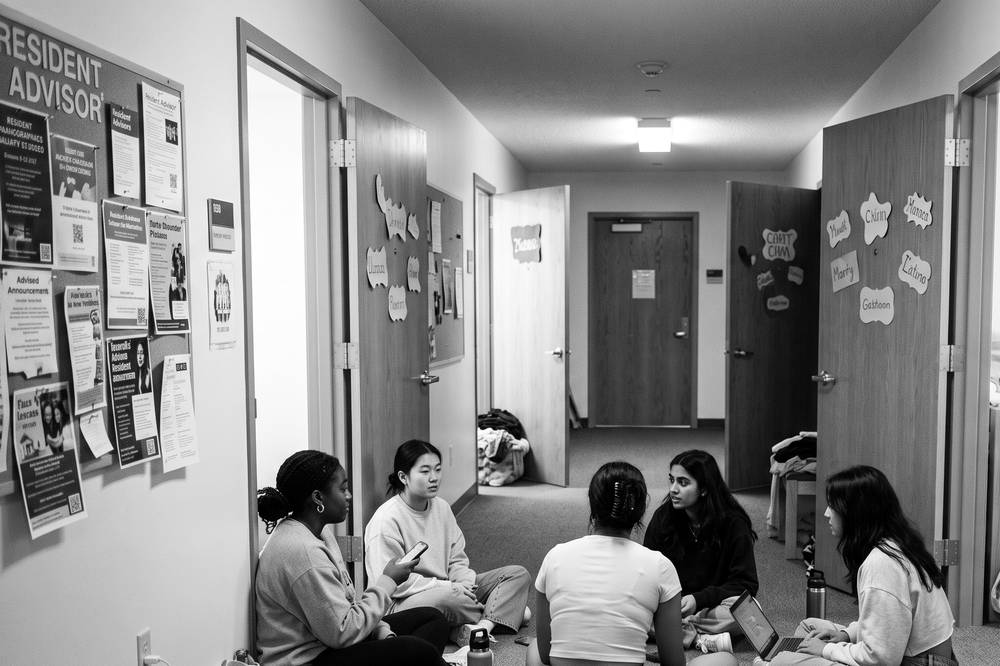
Chapter 2 mentioned the open door — here’s the full case. In a hallway, a closed door is a wall and an open door is an invitation, and nothing else you do this semester communicates as loudly with as little effort. The rooms that prop their doors during the first month become the hallway’s living rooms. People drift in, sit on floors, stay twenty minutes. The residents of those rooms don’t work harder at friendship — they just lowered the toll.
Treat the door as a dial, not a statement of identity.
- Open while unpacking, while watching something skippable, and during the after-dinner drift hours when the hall is alive. That’s the social setting.
- Closed for real work, for sleep, and for the introvert recharge that Chapter 9 will defend as a legitimate need and not a failure.
- The mistake isn’t a closed door — it’s a door that’s never open, which after about three weeks the floor stops testing.
And when you walk past other open doors, that’s the invitation working in reverse. Lean in. ‘What are you watching?’ is a complete social strategy. The hallway’s whole economy runs on people pretending they had a reason to stop.
The First-Month Behaviors That Compound
A floor’s culture sets in about six weeks, the same window as everything else in this book, and it’s built out of almost embarrassingly small behaviors.
- Learn names fast and use them. Keep notes in your phone if you have to (‘Maya, 314, nursing, hates mornings’). Being greeted by name in week two is startlingly powerful, and the person who does it becomes the person everyone knows.
- Say yes to the low-stakes drift. The dining hall walk, the store run, the terrible movie in the lounge. Each one is a deposit in the proximity-repetition account, and Chapter 5 will show the compounding math.
- Do easy homework in the lounge sometimes instead of your room. Visible, interruptible presence is how you become part of the floor’s furniture, in the best sense.
- Bring one prop. Every floor develops gravity wells — the room with the good snacks, the guy with the projector, the girl with the tool kit everyone borrows (that’s you, from Chapter 2). A doorstop and a candy bowl, a deck of cards, a lint roller people can borrow. This isn’t buying friends. It’s giving the proximity machine a reason to repeat.
- Go to the floor events. Yes, the RA’s ice cream social with the construction-paper flyer. It is not about the ice cream. It is a room where every single person has pre-agreed to be introduced — a condition that will occur perhaps five more times in your entire life. Twenty minutes, learn three names, leave whenever.
The students who skip every floor event because they’re ‘cheesy’ are correct about the cheese and wrong about everything else.
Bathrooms, Laundry, Microwaves: The Commons Test
Every hall has commons — bathrooms, laundry, kitchens, lounges — and the commons are where your reputation is actually written. Nobody on your floor knows your GPA. Everybody knows who leaves hair in the shower drain, who takes wet clothes out of a washer and drops them on the table, whose exploded burrito is fossilizing in the microwave, who treats the lounge TV as personal property.
The code is short, costs four minutes a week, and buys the most valuable neighborhood asset there is — being someone nobody has a story about.
- Leave shared spaces the way you’d want to find them.
- Set timers for your laundry. The abandoned-dryer offense is the number-one commons crime in every hall in America.
- Claim nothing you can’t defend, and clean the thing you exploded.
The co-ed bathroom deserves one honest paragraph, because it’s the thing freshmen are too embarrassed to ask about. Yes, it’s strange for about ten days. Then it becomes plumbing. Everyone is exactly as eager as you are to get in and out with dignity intact. A bathrobe from the Chapter 2 list, shower shoes, and eye contact reserved for the sink line is the entire etiquette. Ten days. Then you’ll never think about it again.
The RA: Your Building Comes With a Professional
Meet the most misunderstood job on campus. Your Resident Advisor is not a hall monitor, not a narc with a lanyard, not the fun police. Your RA is a trained upperclassman being paid (usually in free housing) to know things you don’t and to handle problems you can’t. They know which dining hall is good on which night, which professors to avoid at registration, how to get facilities to actually fix the heater, what the add/drop form needs, and where everything is. They are also, per Chapter 3, your built-in mediator — and, as Chapter 9 will show, your fastest connector to real help when a night goes wrong. Theirs is the door you can knock on at 2 a.m. That’s the job.
Chapter 7 will hand you a whole playbook for professors — run it on your RA now, in miniature. Introduce yourself in week one, when you need nothing. Learn their name, let them learn yours, ask one real question. An RA who knows you as ‘the friendly one in 312’ before any problem exists will move mountains when a problem does. RAs keep the same quiet ledger professors do, and the students on the good side of it get warnings where others get write-ups, help where others get shrugs.
One boundary to respect — the RA is also a student, with midterms and a life, doing a job with terrible hours. ‘Thanks, I know this is your Tuesday night’ is a sentence that will make you their favorite resident. It’s also just true.
Floormates Are Not Roommates: The Looser Treaty
The skills from Chapter 3 apply down the hall, but the treaty is looser and the tools are lighter.
- Noise through walls gets one friendly in-person request before any escalation. ‘Hey, we can hear the speaker in 310 — can you pull it back after midnight?’ It works nine times out of ten, because most noise is oblivious, not hostile.
- The floor group chat is for logistics and jokes, never for conflict. A grievance posted to the chat becomes the floor’s entertainment and your reputation problem, per the passive-aggression physics you already know.
- The drama that ripples down the hall by October — the falling-out, the couple, the borrowed-and-unreturned — is weather you can watch without joining. The neighborhood’s most durable citizens are friendly with every faction and enlisted by none.
One more floormate art — the graceful decline. You’ll be invited to things you don’t want to do, by people you like, at volumes you can’t sustain. ‘Can’t tonight, but come get me next time’ is the entire story. A no to the event, a yes to the relationship. Use it freely. The door-as-dial principle applies to your whole social life. The goal is never maximum open. It’s deliberate open.
If Your Floor Is a Dud
Fairness requires this section — some floors just don’t take. A quiet floor, a fragmented floor, a floor where the doors stayed shut. It happens, through no fault of yours, and if it’s yours, the diagnosis matters. You are not bad at college. You drew a slow neighborhood. The machine still works; it just needs more fuel from you, or a different building.
- Borrow a livelier floor through one friend from class. Floors adopt outsiders readily — every hall has honorary residents.
- Shift your proximity-repetition venues to the places Chapter 5 opens up. Clubs, campus jobs, study groups, the gym at the same time every day.
- Note it for housing selection in the spring, when you’ll choose your building on purpose with a year’s intelligence.
The dud floor is disappointing, not defining. The principle underneath this whole chapter travels anywhere there are humans on repeat. Show up, be findable, learn names, keep the commons clean, and let repetition do what it has always done. Speaking of which — the six-week window this book keeps mentioning? It’s time to talk about it directly. Turn the page before it closes.