PART ONE — FOR THE STUDENT
Chapter 9
The Hard Weeks: Homesickness, Slumps, and Knowing When to Get Real Help
Every college year contains some hard weeks. Nobody put that on the brochure, so consider this your notice — and your plan.
Somewhere in your first semester — often around week four, though it keeps its own calendar — most freshmen have a night when the whole thing stops feeling like an adventure. Maybe it’s homesickness arriving all at once. Maybe it’s exhaustion, or a bombed quiz, or the creeping suspicion that everyone else received a handbook you didn’t. For some students it’s one rough night. For others it’s a stretch of gray weeks. Almost nobody gets through freshman year without a version of it, and almost nobody says so out loud — which is exactly why it feels like a personal defect when it’s actually just NORMAL.
Two decades of advising tells me something you should hold onto. The students who ended up fine were never the ones who didn’t struggle — I’m not sure I ever met one of those. They were the ones who KNEW what was normal, had a small menu of moves ready, and knew exactly where the line was between handling a hard week themselves and getting real help. All three of those are learnable, and all three are in this chapter.
So here is the note, and it’s the sentence I most want you to remember from this entire half of the book. A hard week is NORMAL, and it will pass. What follows is the navigation tool — homesickness and its actual schedule, the difference between recharging and hiding, the avoidance spiral and its exit, and the two-week line where a slump earns professional attention. Plus one section that isn’t about you at all, because on every floor, somebody’s hard week belongs to the neighbor.
Homesickness Has a Schedule
Chapter 5 warned you about this and here’s the full picture. Novelty carries almost everyone through the first two weeks — too much is happening to miss anything. Then the newness wears off, the work gets real, and homesickness lands hardest in weeks three through six, directly on top of the friendship window. That timing is cruel but it isn’t random. It’s the moment your brain finishes cataloging everything predictable it lost — whoever and whatever made home feel like home — and files a formal complaint.
Know two things about it. First, it says nothing about whether you chose the right school — homesickness hits transfers, seniors, and study-abroad students in their forties. Second, nearly everyone around you has a version of it, including the people posting the happiest on Insta and TikTok. A useful perspective: homesick means you had a home worth missing. That’s an asset, not a flaw.
What actually works, from watching thousands of freshmen ride it out:
- Stay on campus most weekends early on. The students who go home every weekend keep the wound open and miss the exact weeks when campus friendships form. TRUST ME on this one — the fastest cure for missing home is making here feel like yours, and that only happens if you’re here.
- Schedule the calls instead of the constant drip. A Sunday call you look forward to beats a nonstop text thread that keeps one foot planted at home. Whoever your people are back home, put the call on the calendar and let the space between calls belong to campus.
- Import one missing thing. The show you always watched with somebody, the recipe, the Saturday-morning run. Rituals transplant surprisingly well, and they turn missing into continuity.
- Say it out loud to someone here. ‘I’m weirdly homesick this week’ converts shame into normalcy, and the answer is almost always ‘me too.’ Now it’s a conversation instead of a secret.
Expect it in waves rather than a steady line — it spikes on bad days and family occasions, and for most students it fades noticeably by midterms, right around when campus quietly starts being ‘yours.’ If it doesn’t fade, or it deepens instead, the two-week line later in this chapter is built for exactly that.
Recharge Is Maintenance. Hiding Is Not.
Chapter 4 promised a defense of the introvert recharge, and here it is. College — especially a residence hall in September — is one of the most relentlessly social environments ever constructed. If being around people drains your battery instead of charging it, weeks of forced constant company will grind you down, and needing to close the door and be alone is not a social failure. It is maintenance, exactly like the sleep and vegetables of Chapter 8. That’s what the refuge corner from Chapter 2 was built for — and it’s why the door-as-a-dial idea matters. Closed sometimes is healthy. The question is which kind of closed.
Because there is a counterfeit version of recharge, and learning to tell them apart may be the most valuable skill in this chapter. Recharge has a return time. Hiding doesn’t.
- Recharge is a choice with an ending — ‘I’m in for tonight, see you at breakfast.’ Hiding is automatic and open-ended — the third straight night in, with no plan to surface.
- Recharge leaves you better — after the quiet evening, you actually feel restored. Hiding leaves you worse — lonelier, heavier, and a little more dreading of the hallway than yesterday.
- Recharge coexists with your commitments. Hiding starts eating them — the club skipped, the dinner canceled, the class slept through.
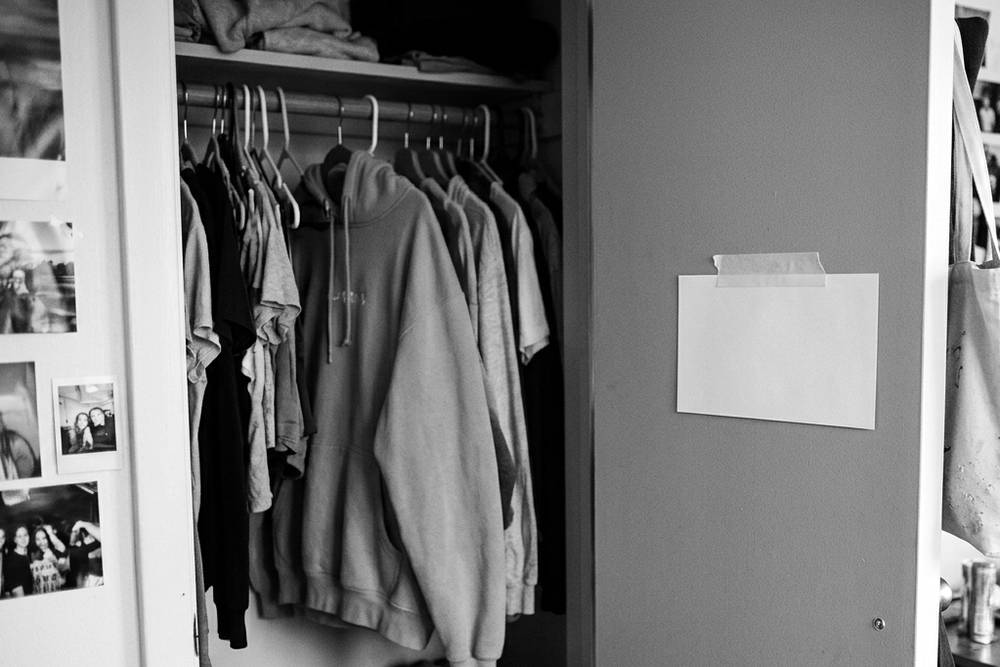
Sometimes the right recharge leaves campus entirely — a quiet coffee shop where nobody knows you is a legitimate reset button (your hall’s around-campus guide at ElevateMyDorm.com marks the coffee spots near the dorms, including the quiet ones). And on a good day — this matters, do it on a GOOD day — build your bad-day menu. Write down three actions that reliably bring you back. A walk with a particular playlist, a call to a particular person, a particular meal with a particular friend. Tape the card inside your closet door. When a bad day arrives, you don’t have to think, and per Chapter 1, any bad day needs an option that isn’t ‘hide.’ PLAN the option while planning is easy.
The Avoidance Spiral (and the Exit)
Chapter 6 named the avoidance spiral and promised the exit. First, the anatomy, because knowing the machine is half of beating it. You miss one class or one assignment — it happens to everyone. But now the class has a little shame attached, so thinking about it feels bad, so you don’t. Skipping the thought becomes skipping the class, each absence makes returning feel more impossible, and within three weeks a single missed Tuesday has metastasized into a course you can’t look at. The spiral runs on exactly one fuel — the belief that it’s too late. It is never as too late as the spiral makes it feel it is.
The exit has four steps, in this order:
- Go back to the thing physically at its very next occurrence. No announcement, no dramatic re-entry, no catching up first. Walk in, sit in your seat neighborhood, take notes. Attendance first, feelings later.
- Send the professor the two-sentence email. ‘I’ve missed the last two classes and I’m getting myself back on track. Could I come to office hours this week to see what to prioritize?’ No confession, no essay of excuses — professors have seen this spiral a hundred times, and per Chapter 7’s ledger, the student who resurfaces on their own moves straight to the good side of it.
- Do the newest work first, not the oldest. This feels backwards and it is the whole trick. Being current stops the spiral today; the backlog gets negotiated at office hours or triaged later. Students who try to backfill first stay behind forever and quit twice.
- Tell one human what happened. Roommate, friend, RA, parent — anyone. Spirals are grown in secrecy, and saying ‘I fell behind and I’m fixing it’ out loud cuts the shame supply.
One institutional tip while we’re here, because it’s the safety net nobody reads about until it’s too late. KNOW your registrar’s drop and withdrawal deadlines — they’re published dates, put them in your phone with the exam dates. If a course is truly unrecoverable, a W on a transcript is a shrug where an F is a scar, and a conversation with your advisor BEFORE the deadline beats both. That conversation is the adult version of the spiral exit, and advisors have it every single semester with students far less on top of things than you are for having read this paragraph. Keep in mind that a withdrawal usually means you don’t get a refund on the tuition you paid for that class, but it’s still better than an F grade. Also, a withdrawal could mean you need to take an extra class in the spring or summer term to maintain your full-time status — a quick email or appointment with your advisor will give you the answer.
The Two-Week Line: When It’s More Than a Slump
Everything so far — the homesick wave, the drained battery, the spiral — responds to the ordinary maintenance moves. Sleep, food, a recharge night with a return time, one honest conversation, the four-step exit. Ordinary bad weeks bend to those. So here is the line, and I want you to set it now, while you feel fine. When roughly two weeks pass and the usual moves have stopped working — or you’ve stopped caring enough to try them — that is no longer a discipline problem. That is the line, and crossing it means it’s time to bring in a professional.
What the far side of the line tends to look like:
- Sleep changing in either direction — can’t fall asleep, or sleeping twelve hours and napping through afternoons to skip the day.
- Appetite quietly leaving, or eating on autopilot without tasting anything.
- Things that were reliably fun going flat — the show, the game, the people.
- Canceling on people repeatedly, and feeling relief instead of disappointment each time.
- A hopeless mist creeping into your thoughts about the semester, or about yourself.
None of those alone on a random Tuesday means anything — everyone has flat days. It’s the combination, the duration, and the not-responding-to-maintenance that marks the line. And one thing is different in type. If your thoughts turn toward hurting yourself, the two-week rule is canceled — that is an immediately, ‘right NOW’ kind of signal. RIGHT NOW — the 988 Suicide and Crisis Lifeline works by call or text from any phone at any hour, your campus almost certainly has its own after-hours crisis line, and your RA’s door at 2 a.m. is real and staffed by someone trained for exactly that knock (Chapter 4 told you — that’s the job). You will probably never need any of those. Keep the info in case you do, or in case it happens to someone you know. Nothing, absolutely NOTHING at college is worth hurting yourself.
The Counseling Center Is an Office-Hours Move
Now the destination on the far side of the line, and the reframe that gets students through the door. You already learned this book’s highest-return move in Chapter 7 — walking into a professor’s office hours instead of struggling alone. The counseling center is the identical move applied to a different subject. Same logic, same early-beats-late math, same quiet ledger of people being far more helpful than freshmen expect. Small and early beats big and late — Chapters 7 and 8 already taught you that rule. It applies to your mind, too.
The practical facts, because mystery is half the barrier:
- You’ve usually already paid for it. At most schools, counseling comes bundled with your fees — free or nearly free for short-term sessions. You are not buying therapy; you’re using a service you own.
- The first visit is boring in the best way. A form, a conversation with a person whose entire job is college students, and a plan. Nobody assigns you a diagnosis in the lobby, and counseling records are kept separate from your academic file.
- Demand is real, so early beats late here too. Waitlists grow as the semester ages — one more reason the week-ten version of you will thank the week-two version who already knows how booking works. Many centers hold same-day slots for urgent situations — KNOW whether yours does.
- It is not a forever commitment. Plenty of students go three times, get a toolkit for the specific thing, and are done. Going once obligates you to nothing.
Find the building in week one, the way you found the dining hall and the clinic. Put the location, hours, and booking method in your phone next to the Chapter 8 clinic entry. You’re not committing to going. You’re stocking the kit, so that if a February version of you needs it, the only step left is walking.
If It’s Your Floormate
One section for the other side of the door, because on every floor, every year, somebody’s hard weeks belong to the neighbor — the floormate who hasn’t been at dinner in a while, whose door stopped opening, who went quiet in the group chat. You’ll notice, because neighbors notice. Here’s what to do with what you notice.
- Say the small true thing, gently. ‘Haven’t seen you at dinner lately — you good? Want to walk over?’ An invitation beats an interrogation every time, and ‘want to come?’ is easier to accept than ‘what’s wrong?’
- Accompany, don’t diagnose. Your job is walks, meals, sitting nearby, and ‘me too’ — not figuring out what’s clinically happening. You are not your floor’s therapist. You’re their neighbor, and neighborly is the actual assignment.
- When worry reaches the safety level, tell your RA — that day. If someone talks about hurting themselves, gives things away, or disappears from all contact, that is above your pay grade by design. Telling the RA is not betrayal or drama. It is literally what the 2 a.m. door exists for, and RAs are trained on exactly what to do next. Let the professionals be professionals; you be the friend.
And notice the mirror. Everything in this chapter about your floormate is what your floormates would do for you — which is one more reason the Chapter 4 neighborhood was worth building. People who know your name notice when you’re missing. That’s not surveillance. That’s the safety net, and you’re a strand of it.
That’s the hard-weeks map — and with it, your half of this book has covered the room, the people, the systems, and the storms. One chapter remains, and it’s the one you’ll actually reread all year. The questions everyone has and nobody asks out loud.