PART ONE — FOR THE STUDENT
Chapter 6
Time Is the Only Thing You Own Now
Nobody fails college because they aren’t smart enough. They fail because Tuesday disappeared, seventy times in a row.
Back in Chapter 1 we did the freedom math. A week has 168 hours, and after class and sleep, roughly seventy of them belong to no one but you. Nobody schedules them, nobody audits them, and nobody will ever ask where they went.
Here is what two decades of watching freshmen taught me about those seventy hours. The students who struggled almost never had a motivation problem, and they certainly didn’t have an intelligence problem. They had a visibility problem. Time they couldn’t see was time they couldn’t spend on purpose, so it spent itself — one more episode, one more scroll, one more ‘we ordered food and suddenly it was 2 a.m.’
This chapter makes your time visible, then hands you the four tools that do the actual work — a calendar with three layers, a fifteen-minute Sunday habit, a set of phone rules, and a way to start tasks you’re dreading. None of it requires discipline in the movie-montage sense. Discipline is mostly what visibility looks like from the outside.
The Three-Layer Calendar
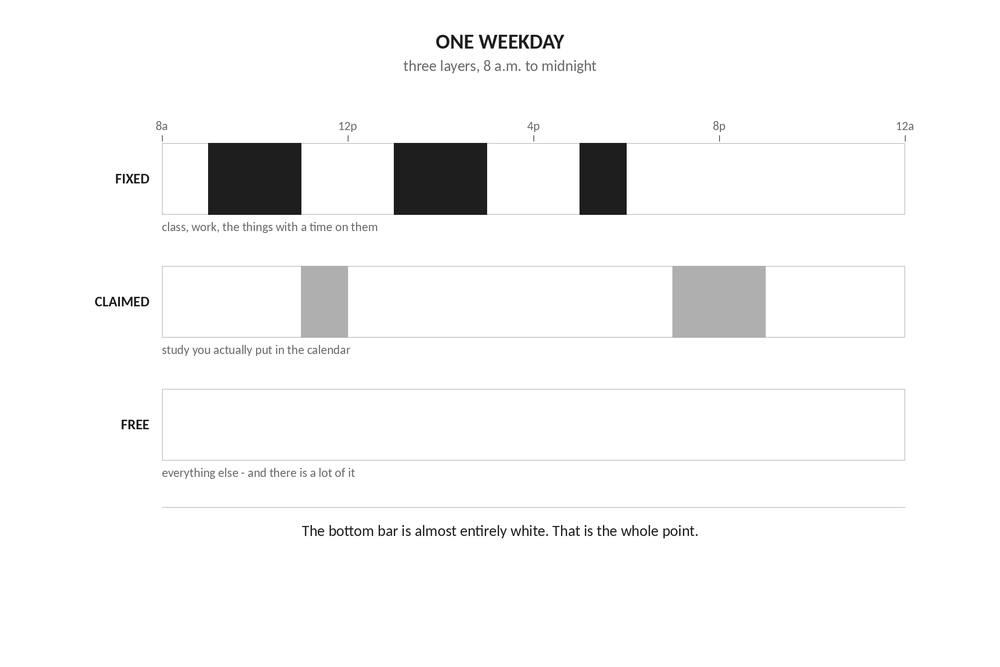
Every functioning college schedule is three layers stacked on one calendar. Most freshmen only build the first layer, and that’s the whole problem.
- Layer one — fixed time. Classes, labs, work shifts, practices, and your two commitments from Chapter 5. These arrive already scheduled. Enter them once, set them to repeat, and include the exam and paper dates you loaded from every syllabus in week one (the Week-One Five, promise kept).
- Layer two — claimed time. The hours you assign on purpose, before the week starts. Study blocks tied to specific courses, meals at tables with humans, the gym, laundry, and the Sunday Reset below. This is the twenty-five-hours-on-purpose idea from Chapter 1, now with an address.
- Layer three — free time. Everything left over, and here’s the part that surprises people — you protect this layer just as fiercely. Free time you’ve earned by claiming layer two is guilt-free, restorative, and enormous. Free time that’s really just unclaimed layer-two work follows you around all day like a debt collector.
Two rules make the layers hold. First, claimed time gets scheduled at your strong hours, not your leftovers — for almost everyone that means daylight, between and right after classes, when campus is awake and your brain still works. The freshman cliche of ‘I’ll study tonight’ quietly converts your best hours to scrolling and your worst hours to calculus. Second, a study block names its course. ‘Study 7–9’ is a wish. ‘Chem problem set, 3:00–4:30, library third floor’ is an appointment, and you’ll learn quickly that a specific floor is where your focus lives (every library has a personality per floor — find yours in week two).
The Sunday Reset (Fifteen Minutes That Replace the Scaffolding)
Chapter 1 promised you the full version of the Sunday check-in. Here it is — the single habit that replaces most of what the high school scaffolding used to do for you. Fifteen minutes, every Sunday, same time, with your calendar and syllabi open. (Sunday evening works best for most people, but any consistent weekly slot counts.)
- Scan two weeks ahead. Read your calendar and every course’s due dates through the next fourteen days. You are looking for the wave before it breaks — the week where two exams and a paper land together. Those weeks are survivable only when spotted early.
- Claim the blocks. Place next week’s study blocks against what’s actually due, biggest deadline first. If a big assignment is more than a week out, claim its first ugly hour anyway (more on ugly first hours below).
- Settle the logistics. Laundry, groceries, any forms or emails owed to the adults in your life — registrar, professors, housing, parents. Two minutes of list-making here prevents the Thursday scramble.
- Check the money. One glance at the week’s spending against your weekly number — Chapter 8 will set that number and give you the tools. Thirty seconds. Just look.
- Check yourself. Three questions, honestly. Am I sleeping? When did I last do something with people? Is anything sliding that’s still cheap to fix? If a course is sliding, that’s your cue for the 48-hour rule Chapter 7 will give you — and if you are sliding, that’s Chapter 9, and it belongs on this checklist as much as anything academic.
That’s the whole ritual. Students who run it describe the same effect — the week stops happening to them. And notice what the reset really is. It’s you, checking on you, weekly, before the institution checks monthly with a grade. That was the scaffolding’s most important job, and it’s yours now.
Your Phone Is a Roommate Too
Let’s skip the lecture about screen time — you’ve heard it, and this book doesn’t need to repeat it. Instead, one reframe and three mechanical rules from students who actually made it work.
The reframe. Your phone is a roommate. It lives with you, it talks constantly, it has no idea you have an exam, and it will happily keep you up until 3 a.m. every night forever. You wrote a treaty with your human roommate in Chapter 3. The phone gets one too, and yours is the only signature required.
- The desk rule. Chapter 2 made your desk a one-purpose surface, and this is why. When you sit down for a claimed block on your calendar, the phone goes face-down out of reach or in the drawer — not because of willpower, but because reaching is friction and friction is the entire science of habit. A block with the phone in the drawer is worth roughly two with it on the desk.
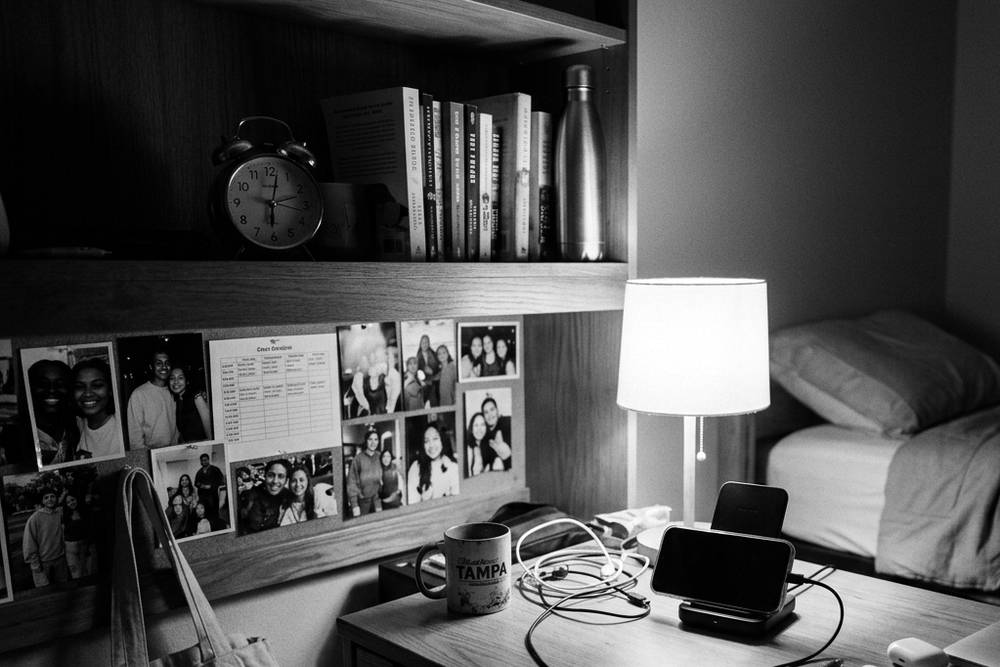
- The bed rule. The phone charges at the desk overnight, not on the pillow. This single rule improves sleep more than any product on the market, and it makes your alarm — now across the room — a physical commitment to actually standing up. (A cheap real alarm clock is on the Chapter 2 list’s honorable mentions for exactly this reason.)
- The walk rule. Cross campus with your head up a few times a day. Partly because the Chapter 4 neighborhood runs on hallway and sidewalk collisions, and partly because unscheduled thinking time turns out to be where essays get outlined and problems get unstuck. Boredom is a productivity tool that got a bad reputation.
Starting Is the Whole Battle
Procrastination in college is nearly universal, and it is almost never laziness. It’s the size of the thing. ‘Write the ten-page paper’ is too big for a human brain to start, so the brain does the dishes, organizes the closet, and reads about time management instead. (Hello.)
The fix is mechanical, not moral. Shrink the entry point until starting is easier than avoiding.
- Cut every big task into starts. Not ‘write the paper’ but ‘open a doc and write the worst possible first paragraph.’ Not ‘study for the midterm’ but ‘make the list of what the midterm covers.’ A task you can start in ninety seconds is a task that gets started.
- Use the ten-minute contract. Agree to work on the dreaded thing for ten minutes with permission to quit after. You will quit maybe one time in ten. Momentum is real; the contract just tricks you past the border.
- Let the first version be ugly. Perfectionism is procrastination wearing a nicer outfit. The ugly first draft, the wrong first attempt at the problem set — these are the raw material every good final version is made of, and they are the exact thing office hours can work on when you bring them to your professor (a Chapter 7 preview — professors can fix ugly; they cannot fix blank).
- Pair the miserable with the pleasant. The dreaded reading goes with the good coffee shop, the flashcards with the walk, the problem set with your study group — which, you’ll remember from Chapter 5, is a social play and an academic play at the same time.
One honest boundary. If avoidance has stopped being ordinary procrastination — if you’re avoiding a course entirely, skipping it to escape the feeling of being behind — that’s no longer a time problem. That’s a spiral, it compounds weekly, and the exits are the 48-hour rule with the professor (coming in Chapter 7) and the campus resources (coming in Chapter 9). The earlier you take an exit, the easier it is. There is no version where waiting helps.
In Defense of the Unscheduled Hour
This is the section the productivity books skip, and it might be the most important one in the chapter. You know the overscheduled student — calendar like a subway map, nine commitments, walking fast everywhere, quietly miserable by November. Chapter 5 warned you about becoming them, and the calendar version of the warning is this. A schedule with no slack isn’t impressive, it’s brittle. One sick day, one hard week, one friend in crisis, and the whole tower falls over — taking your sleep and your mood with it.
So the three-layer calendar deliberately leaves the third layer big. Empty hours are where naps happen, where the two-hour dining hall conversation happens, where the Chapter 4 open-door drift happens, where you actually become a person instead of a resume. You claimed twenty-five hours on purpose precisely so the other forty-five could be genuinely, unapologetically free.
The test of a good college schedule was never fullness. It’s this — are the claimed hours truly claimed, and are the free hours truly free? Get those two things and you’ll be that student other freshmen can’t figure out, the one with good grades who never seems frantic. The trick was never speed. It was visibility, a Sunday habit, and a phone in a drawer.
Now, about that thirty-second money check the Sunday Reset just added to your week — it’s time to talk about where the money actually goes. Turn the page.